
Particle Orbits in Central Potential
Orbits of particles in a  potential are illustrated. The position of the central singularity is at
 . The particle orbits are calculated according to the equations of motion
 potential are illustrated. The position of the central singularity is at
 . The particle orbits are calculated according to the equations of motion


where  and
 , the constant
 is a constant of integration corresponding to the angular momentum.
 and
 , the constant
 is a constant of integration corresponding to the angular momentum.
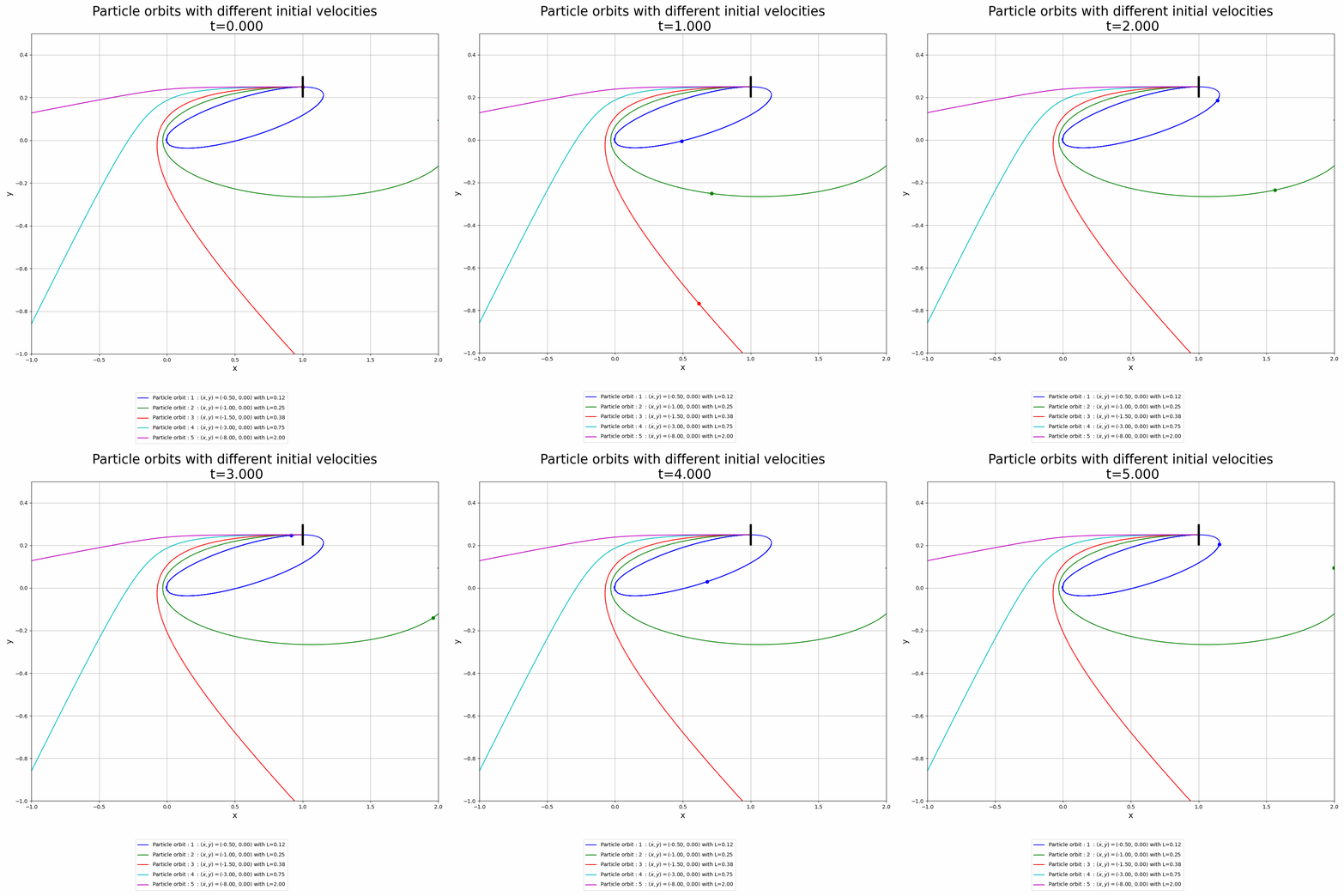
 . In addition all particles have the same initial velocity
 , while the velocity
 in
 direction is different. The different values for the angular momentum
 result from this different value of